Introduction
Modern agriculture is being challenged to produce more while using fewer resources. Water availability is becoming increasingly limited in many regions, while production costs, energy prices, and yield expectations continue to rise. At the same time, growers are expected to improve sustainability, optimize fertilizer use, and maintain consistent crop quality season after season.
In this environment, selecting the right irrigation system is no longer simply an engineering decision—it is a business decision.
The irrigation method you choose influences nearly every aspect of crop production, from water consumption and fertilizer efficiency to labor requirements, crop uniformity, energy use, and long-term operating costs. A well-designed irrigation system can help maximize the value of every drop of water, while the wrong choice may limit productivity for years to come.
Today’s growers have access to a wide range of irrigation technologies. Traditional surface irrigation methods continue to serve specific agricultural applications, sprinkler systems remain popular across broad-acre farming, and precision irrigation methods—particularly drip irrigation and Subsurface Drip Irrigation (SDI)—are helping farms improve water-use efficiency while supporting healthier, more uniform crop development.
However, there is no universal solution.
The best irrigation system depends on your crop, soil characteristics, field topography, climate, water availability, irrigation water quality, and long-term production goals.
This guide explains the major types of irrigation systems used in modern agriculture, compares their strengths and limitations, and provides practical guidance to help growers, consultants, and irrigation planners select the most appropriate solution for their specific conditions.
1. What Is an Irrigation System?
An irrigation system is an engineered network designed to supply crops with water in a controlled and efficient manner whenever natural rainfall cannot fully satisfy plant requirements.
While its primary purpose is to maintain adequate soil moisture for healthy crop growth, modern irrigation systems do far more than simply deliver water.
A properly designed irrigation system helps growers:
- Apply water precisely when crops need it
- Improve irrigation uniformity across the field
- Reduce water losses through runoff or evaporation
- Support efficient fertigation programs
- Increase operational efficiency through automation
- Improve long-term crop consistency
Modern agriculture relies on several fundamentally different irrigation methods.
Some systems use gravity to distribute water across the soil surface, while others apply water through pressurized sprinklers or deliver it directly to the root zone using driplines and emitters. Each approach offers different advantages depending on the production system.
There Is No Universal “Best” Irrigation System
One of the biggest misconceptions in irrigation planning is that one technology outperforms all others.
In reality, the most effective irrigation system is simply the one that best matches the conditions of a particular farm.
The right choice depends on several factors, including:
- Crop type
- Soil texture and infiltration rate
- Field topography
- Climate conditions
- Water availability
- Irrigation water quality
- Available labor
- Farm size
- Budget and long-term return on investment
Understanding these variables before investing in irrigation infrastructure helps growers maximize productivity while avoiding costly design mistakes.
2. Why Choosing the Right Irrigation System Matters
For many farms, an irrigation system will remain in operation for decades.
That makes irrigation selection one of the most important long-term investments in agricultural production.
While installation cost often receives the most attention, it represents only a fraction of the total cost of ownership. Water use, energy consumption, maintenance requirements, fertilizer efficiency, labor, and crop performance all influence the long-term return on investment.
The right irrigation system helps optimize these factors simultaneously.
Water Efficiency
Water has become one of agriculture’s most valuable production inputs.
Efficient irrigation reduces unnecessary evaporation, runoff, and deep percolation while delivering water where plants can use it most effectively.
Surface irrigation, sprinkler irrigation, drip irrigation, and SDI each manage water differently, resulting in significant differences in application efficiency depending on local conditions.
For growers operating in water-limited regions, irrigation efficiency can directly influence both profitability and long-term farm resilience.
Crop Yield and Quality
Uniform irrigation creates more uniform crops.
When plants receive consistent moisture throughout the field, they experience less water stress during critical growth stages. This contributes to more even crop development, improved quality, and greater production consistency.
Modern drip irrigation systems are specifically designed to achieve high levels of irrigation uniformity, even across long laterals or fields with changing elevations when pressure-compensating technology is used.
Metzer’s pressure-compensating driplines, for example, use engineered flow paths and silicone diaphragm technology to help maintain consistent emitter discharge across varying operating pressures. This supports more uniform irrigation under challenging topographic conditions and in large commercial installations.
Fertigation Efficiency
Modern irrigation systems are also nutrient delivery systems.
Through fertigation, fertilizers can be applied together with irrigation water, delivering nutrients directly into the active root zone throughout the growing season.
Compared with conventional fertilizer applications, fertigation improves nutrient placement while helping reduce waste and improving management flexibility.
Precision irrigation systems are particularly well suited to fertigation because water and nutrients are applied only where crops require them.
Continue learning: Drip Irrigation Advantages & Disadvantages
Labor and Operational Efficiency
Automation has transformed irrigation management.
Modern irrigation systems can often be programmed to irrigate according to crop requirements, weather conditions, or soil moisture measurements, reducing manual labor while improving consistency.
Automation also allows growers to respond more quickly to changing environmental conditions, improving operational efficiency throughout the season.
Total Cost of Ownership
The least expensive irrigation system to install is not always the least expensive to own.
When evaluating irrigation options, growers should consider:
- Water consumption
- Energy costs
- Maintenance requirements
- Filtration needs
- Labor inputs
- Expected service life
- System expansion opportunities
Looking beyond the initial investment often provides a more realistic picture of long-term profitability.
Sustainability and Resource Management
Modern agriculture is expected to increase productivity while reducing its environmental footprint.
An efficient irrigation system contributes by helping growers:
- Conserve water resources
- Improve fertilizer use efficiency
- Reduce nutrient leaching
- Minimize runoff
- Improve soil health
- Support sustainable production practices
These benefits extend beyond environmental stewardship—they also improve operational efficiency and help farms adapt to increasing pressure on water resources.
As precision irrigation technologies continue to evolve, growers have more opportunities than ever to improve both productivity and resource management.
Why Precision Irrigation Is Becoming the Preferred Choice
Across many agricultural sectors, irrigation is shifting from simply supplying water to managing crop performance.
Precision irrigation technologies—including drip irrigation and Subsurface Drip Irrigation (SDI)—allow growers to control not only how much water is applied, but also where, when, and how efficiently it reaches the root zone.
Combined with pressure-compensating driplines, advanced filtration, and proper hydraulic design, these systems support highly uniform irrigation even under demanding field conditions.
Metzer has spent decades developing dripline technologies for commercial agriculture, with solutions designed for applications ranging from orchards and vineyards to field crops, greenhouses, and SDI installations. Its portfolio includes pressure-compensating driplines, anti-siphon technologies for subsurface irrigation, and clog-resistant designs developed for reliable performance under challenging water conditions.
Rather than replacing every traditional irrigation method, precision irrigation expands the range of solutions available to growers, allowing each farm to select the system that best aligns with its production goals.
Key Takeaways
Before comparing irrigation systems, remember these five principles:
✔ There is no universally “best” irrigation system.
✔ The right system depends on your crops, soil, water resources, and production goals.
✔ Installation cost should never be the only deciding factor.
✔ Water efficiency, operating costs, and irrigation uniformity often have a greater impact on long-term profitability.
✔ The most successful irrigation projects combine appropriate technology with proper system design, filtration, maintenance, and ongoing management.
3. The Main Types of Irrigation Systems
Modern agriculture relies on several irrigation methods, each developed to address different farming conditions, crop requirements, and water management challenges.
Rather than viewing one system as universally better than another, it is more useful to understand where each method performs best and what trade-offs growers should consider before investing.
The following sections compare the major irrigation systems used worldwide, highlighting their strengths, limitations, and ideal applications.
3.1 Surface Irrigation
Surface irrigation is the oldest irrigation method still widely used in agriculture today. Instead of relying on pumps or pressurized pipelines, water flows across the soil surface using gravity until it infiltrates into the crop’s root zone.
Although modern precision irrigation technologies have significantly improved water management, surface irrigation remains an economical solution in certain regions where land conditions and water availability make it practical.
How It Works
Water is released into prepared fields from canals, reservoirs, or pipelines and moves naturally across the soil surface.
The three most common surface irrigation methods are:
- Basin irrigation – Water is contained within level basins surrounded by small embankments.
- Border irrigation – Water flows through long, gently sloping strips separated by raised borders.
- Furrow irrigation – Water moves through shallow channels between crop rows, allowing moisture to infiltrate toward the plant roots.
Successful surface irrigation depends heavily on proper land leveling, soil characteristics, field dimensions, and careful water management.
Best Suited For
Surface irrigation continues to perform well in situations such as:
- Large, flat agricultural fields
- Regions with abundant water supplies
- Heavy or medium-textured soils
- Farms with limited infrastructure budgets
- Rice, forage, and some cereal production
Advantages
- Low installation costs
- Minimal mechanical equipment
- Low energy requirements
- Straightforward operation
- Proven management practices
Limitations
Despite its simplicity, surface irrigation presents several challenges.
Because water moves across the soil surface, losses through runoff, evaporation, and deep percolation can reduce irrigation efficiency if fields are not carefully designed and managed.
Other limitations include:
- Uneven water distribution on sloping land
- Greater dependence on field leveling
- Increased risk of soil erosion
- More difficult fertigation management
- Reduced suitability where water conservation is a priority
Typical Crops
Surface irrigation is commonly used for:
- Rice
- Wheat
- Barley
- Alfalfa
- Pasture
- Some row crops
Maintenance Considerations
Although surface irrigation has few mechanical components, maintaining good performance requires:
- Regular land grading
- Canal maintenance
- Sediment removal
- Drainage management
- Careful water distribution
Bottom line: Surface irrigation remains a practical choice where water is readily available and installation costs must be kept low, but it generally offers lower irrigation efficiency than modern pressurized systems.
3.2 Sprinkler Irrigation
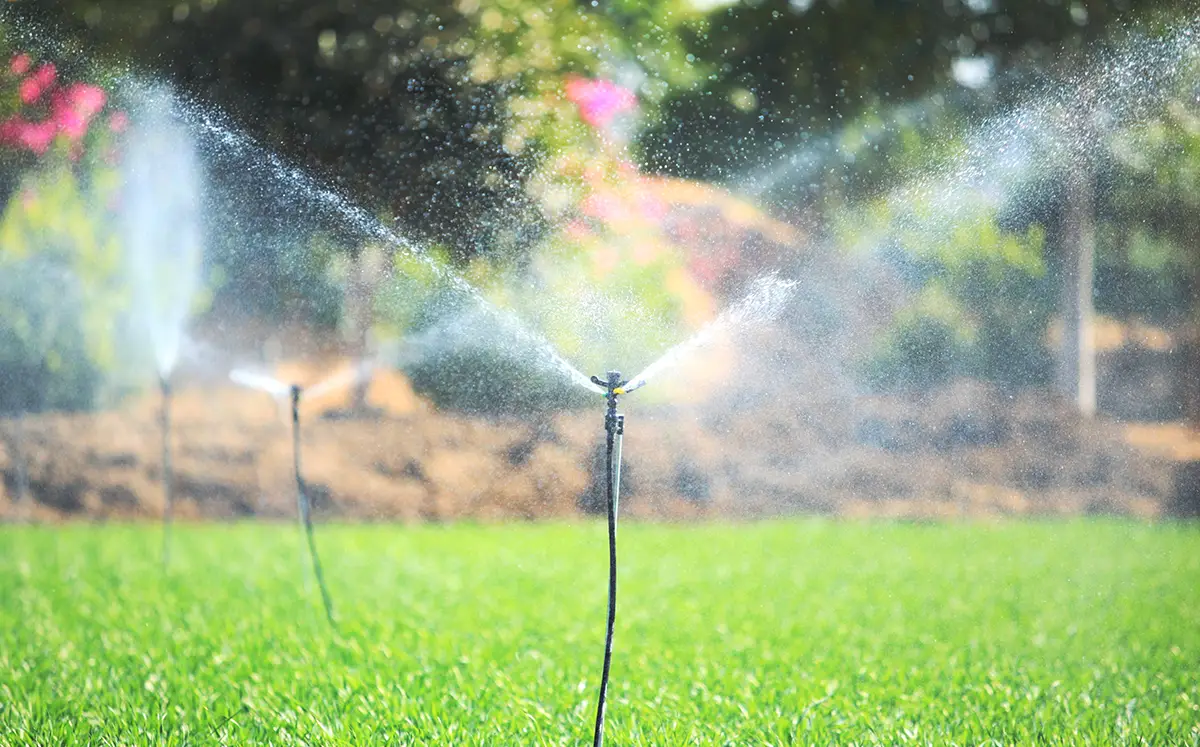
Sprinkler irrigation distributes water through a pressurized network of pipes and sprinkler heads, applying water over the crop canopy in a manner similar to natural rainfall.
It is one of the most versatile irrigation systems available and is widely used across broad-acre agriculture because it can irrigate large fields with relatively uniform water distribution.
Unlike surface irrigation, sprinkler systems are less dependent on field leveling and can be adapted to a wider variety of landscapes.
How It Works
Water is pumped through a pressurized pipeline before being discharged through sprinkler nozzles.
The system’s performance depends on factors such as:
- Operating pressure
- Nozzle selection
- Sprinkler spacing
- Wind conditions
- Application rate
Several sprinkler configurations are commonly used:
- Conventional sprinkler systems
- Center pivot irrigation
- Lateral move (linear) systems
- Solid-set irrigation systems
Many modern installations also incorporate automated scheduling and digital irrigation controls.
Best Suited For
Sprinkler irrigation is often selected for:
- Large field crops
- Cereals
- Potatoes
- Pastures
- Turf production
- Farms with uneven terrain
- Operations requiring flexible irrigation scheduling
Advantages
- Suitable for many crop types
- More uniform than gravity irrigation
- Can irrigate sloping fields
- Easily automated
- Flexible system layouts
- Compatible with large-scale farming
Limitations
Because sprinkler irrigation applies water above the crop canopy, part of the applied water may never reach the soil.
Losses can occur through:
- Evaporation
- Wind drift
- Non-uniform distribution under windy conditions
In addition, prolonged leaf wetting may increase disease pressure in crops that are susceptible to fungal pathogens.
Compared with drip irrigation, sprinkler systems also require:
- Higher pumping pressure
- Greater energy consumption
- More moving mechanical components
Typical Crops
Sprinkler irrigation is commonly used for:
- Corn
- Soybeans
- Wheat
- Potatoes
- Forage crops
- Turfgrass
Maintenance Considerations
Routine maintenance includes:
- Cleaning or replacing nozzles
- Monitoring operating pressure
- Checking pumps
- Inspecting pipelines
- Servicing moving equipment on pivot and linear systems
Well-maintained sprinkler systems can provide consistent irrigation over large production areas for many years.
Bottom line: Sprinkler irrigation offers an excellent balance between flexibility and field coverage, making it a strong option for many commercial farms. However, where maximizing water efficiency is a priority, precision irrigation methods often provide additional long-term advantages.
Continue Learning
If you’re evaluating precision irrigation technologies, these guides may also be helpful:
3.3 Micro Irrigation
Micro irrigation is a family of irrigation methods designed to deliver small, controlled amounts of water directly to the area where plants need it most—the root zone.
Unlike surface or sprinkler irrigation, which wet large portions of the field, micro irrigation applies water with much greater precision. This targeted approach helps improve irrigation efficiency while reducing evaporation, runoff, and unnecessary water application between crop rows.
As water conservation becomes an increasingly important priority, micro irrigation has become one of the fastest-growing irrigation categories worldwide.
How It Works
Micro irrigation distributes water through a network of low-pressure pipes fitted with specialized emitters.
Instead of irrigating an entire field, water is applied gradually and precisely around each plant or planting row.
Depending on the crop and production system, micro irrigation may use:
- Drip emitters
- Driplines
- Micro-sprinklers
- Bubblers
Many systems also support fertigation, allowing growers to apply water and nutrients simultaneously throughout the growing season.
Best Suited For
Micro irrigation is commonly used for:
- Orchards
- Vineyards
- Greenhouses
- Vegetable production
- Nurseries
- High-value specialty crops
- Water-limited agricultural regions
Advantages
- Excellent water-use efficiency
- Precise root-zone irrigation
- Reduced evaporation losses
- Improved fertilizer management
- Lower weed pressure
- Reduced foliage wetting
- Excellent compatibility with automation
Limitations
Like all precision irrigation systems, micro irrigation depends on good engineering and proper maintenance.
To maintain long-term performance, growers should pay particular attention to:
- Water quality
- Filtration
- Pressure regulation
- Periodic flushing
- Routine system inspection
When these factors are managed correctly, micro irrigation provides highly reliable irrigation with excellent uniformity.
Typical Crops
Micro irrigation is widely used for:
- Citrus
- Apples
- Grapes
- Tomatoes
- Cucumbers
- Peppers
- Ornamentals
- Greenhouse crops
Maintenance Considerations
Preventive maintenance is essential.
Regular monitoring of filters, pressure regulators, emitters, and water quality helps maintain irrigation uniformity while reducing the likelihood of clogging.
Bottom line: Micro irrigation represents the shift from irrigating fields to irrigating plants. By delivering water precisely where crops need it, growers can significantly improve irrigation efficiency while supporting healthier crop development.
3.4 Drip Irrigation
Drip irrigation is the most widely adopted form of micro irrigation and one of the most important innovations in modern agricultural water management.
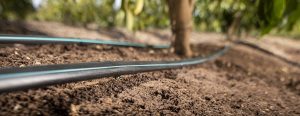
Instead of applying water across an entire field, drip irrigation delivers small, measured amounts of water directly to the plant’s root zone through emitters installed within or attached to a dripline.
This precise application allows growers to maintain more consistent soil moisture while minimizing evaporation, runoff, and unnecessary wetting of surrounding soil.
For commercial agriculture, drip irrigation is no longer considered a niche technology. It has become a proven solution for improving water productivity, supporting fertigation, and producing more consistent crop performance across a wide range of growing conditions.
How It Works
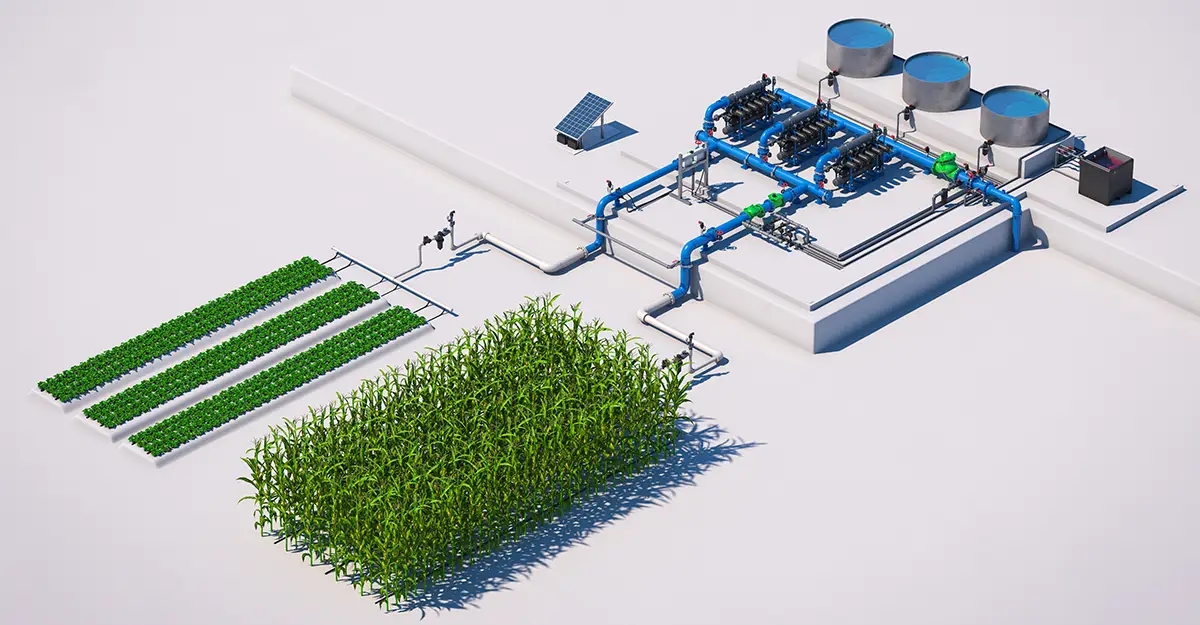
A typical drip irrigation system consists of:
- Water source
- Filtration system
- Pressure regulation
- Mainline and sub-main pipelines
- Driplines
- Emitters
- Control valves
- Fertigation equipment (where applicable)
Water flows through the system under relatively low pressure before being released through each emitter at a carefully controlled flow rate.
Instead of flooding the soil or spraying water over the crop canopy, moisture gradually infiltrates into the active root zone, allowing plants to access water more efficiently.
Why Pressure Compensation Matters
Not every field is perfectly flat.
Changes in elevation, long irrigation laterals, and pressure variations can cause conventional emitters to discharge different amounts of water across the same irrigation zone.
The result is uneven irrigation.
Some plants receive too much water.
Others receive too little.
Pressure-compensating (PC) emitters solve this challenge by regulating flow over a wide range of operating pressures, helping maintain uniform water application throughout the irrigation block.
This becomes particularly important in:
- Orchards
- Vineyards
- Rolling terrain
- Long irrigation runs
- Large commercial fields
Metzer’s pressure-compensating driplines use engineered labyrinth flow paths and silicone diaphragm technology to maintain consistent discharge while providing high resistance to clogging. These design features help support irrigation uniformity even under demanding hydraulic conditions and varying field elevations.
Continue learning: Understanding Drip Irrigation Systems and What Are PC or Non-PC Drippers
Best Suited For
Drip irrigation performs exceptionally well in:
- Orchards
- Vineyards
- Vegetables
- Greenhouses
- Berry production
- Row crops
- Permanent plantations
- High-value specialty crops
It is particularly attractive where water conservation, fertigation, and irrigation precision are priorities.
Advantages
Well-designed drip irrigation systems provide numerous operational benefits.
These include:
- High irrigation uniformity
- Excellent water-use efficiency
- Precise fertigation
- Reduced evaporation losses
- Lower weed pressure
- Reduced leaf wetting
- Improved irrigation scheduling
- Greater flexibility on irregular terrain
By applying both water and nutrients directly into the active root zone, drip irrigation also helps improve fertilizer efficiency while reducing nutrient losses.
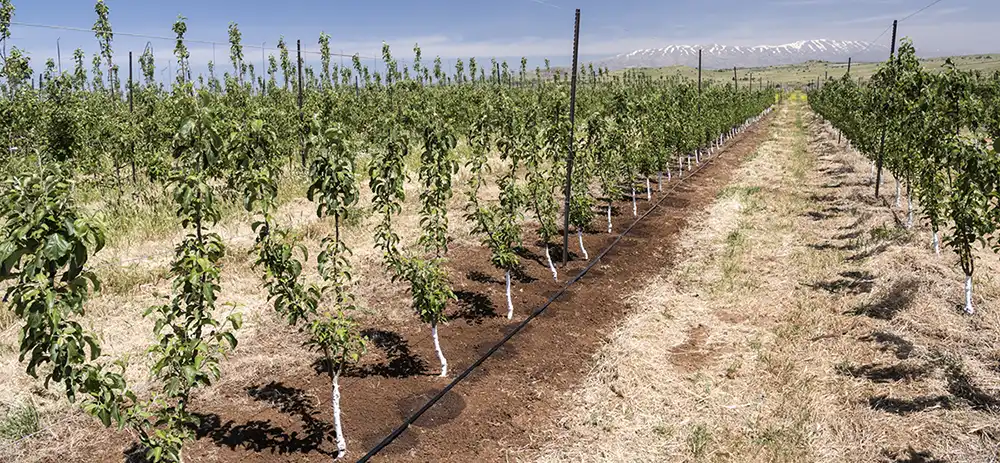
Water Quality and Clog Resistance
One of the most important considerations in any drip irrigation system is water quality.
Suspended solids, biological growth, and mineral deposits can gradually reduce emitter performance if systems are not properly designed and maintained.
For this reason, successful drip irrigation depends on:
- Appropriate filtration
- Proper flushing procedures
- Pressure regulation
- Routine maintenance
- Selecting driplines designed for reliable long-term performance
Metzer has invested heavily in developing clog-resistant emitter technologies and hydraulic designs that support reliable operation across a wide range of agricultural applications, including installations using challenging water sources when paired with appropriate filtration and maintenance practices.
Continue learning: Water Quality for Micro-Irrigation
Typical Crops
Drip irrigation is widely used for:
- Citrus
- Apples
- Almonds
- Grapes
- Tomatoes
- Peppers
- Melons
- Cotton
- Corn
- Greenhouse vegetables
Maintenance Considerations
Like every precision irrigation system, drip irrigation benefits from regular preventive maintenance.
Best practices include:
- Cleaning filters
- Flushing irrigation lines
- Monitoring operating pressure
- Inspecting emitters
- Testing water quality
- Periodically evaluating irrigation uniformity
Routine maintenance helps maximize system lifespan while maintaining consistent irrigation performance throughout the growing season.
Bottom line: Drip irrigation combines precision, flexibility, and resource efficiency, making it one of the most effective irrigation methods for modern commercial agriculture.
3.5 Subsurface Drip Irrigation (SDI)
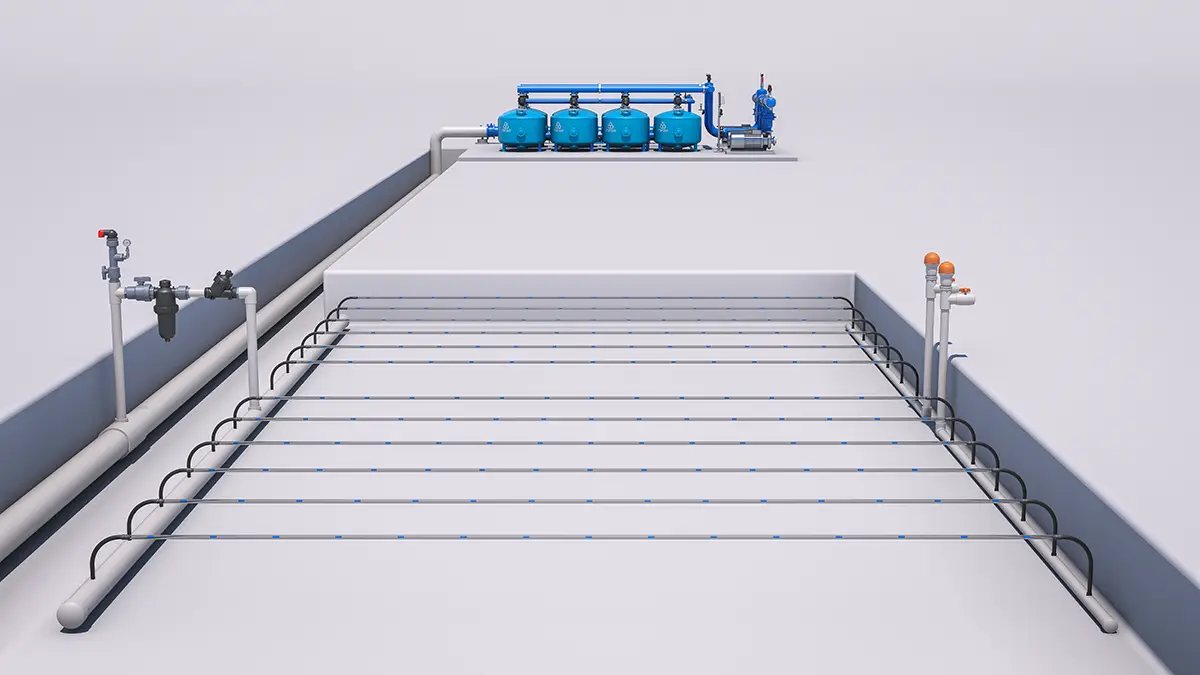
Subsurface Drip Irrigation (SDI) builds on the principles of drip irrigation by placing the dripline beneath the soil surface rather than on top of it.
Instead of applying water at ground level, SDI delivers water directly into the active root zone, allowing crops to access moisture with minimal surface evaporation.
This approach has made SDI one of the most efficient irrigation methods available for many commercial farming systems, particularly where long-term water conservation is a priority.
How It Works
Driplines are installed below the soil surface at depths determined by:
- Crop type
- Root development
- Soil characteristics
- Cultivation practices
Water moves through pressure-compensating emitters beneath the surface, creating controlled wetting patterns around the crop root zone while keeping the soil surface comparatively dry.
Because the irrigation network is buried, the system remains protected from sunlight, machinery, and many forms of physical damage.
Best Suited For
SDI is commonly used for:
- Row crops
- Corn
- Cotton
- Sugar beet
- Alfalfa
- Orchards
- Vineyards
- Permanent plantations
It is particularly valuable in regions where water availability is limited or where growers seek long-term improvements in irrigation efficiency.
Advantages
Compared with surface-installed irrigation systems, SDI offers several unique advantages.
These include:
- Extremely high water-use efficiency
- Minimal evaporation losses
- Reduced weed growth
- Improved fertigation efficiency
- Less interference with field operations
- Protection from machinery damage
- More consistent root-zone moisture
Because the soil surface remains comparatively dry, SDI may also reduce some disease and weed management challenges depending on the crop and production system.
Designed for Long-Term Performance
Installing driplines below the soil surface introduces new engineering challenges.
Systems must be designed to address factors such as:
- Root intrusion
- Soil particle ingestion
- Pressure fluctuations
- Water quality
- Long-term reliability
Metzer’s SDI product range incorporates technologies such as anti-siphon protection, pressure-compensating emitters, and clog-resistant hydraulic designs to help maintain reliable performance in demanding agricultural environments. These systems are also used in projects utilizing reclaimed or treated wastewater where proper filtration, maintenance, and system design are implemented.
Continue learning: Subsurface Drip Irrigation Systems for Row Crops and Orchards
Maintenance Considerations
Although buried systems require less day-to-day physical inspection than surface driplines, preventive maintenance remains essential.
Growers should regularly:
- Monitor operating pressure
- Flush irrigation lines
- Inspect filtration systems
- Evaluate water quality
- Follow recommended maintenance schedules
Proper system management is critical to achieving the long service life that SDI systems are designed to deliver.
Bottom line: For growers focused on maximizing water productivity over the long term, SDI represents one of the most advanced irrigation solutions available today.
Continue Learning
If you’re considering precision irrigation, these in-depth guides can help you explore specific topics in more detail:
4. Irrigation Systems Comparison
Every irrigation method offers a different balance of water efficiency, installation cost, operating expenses, and long-term performance. Rather than asking which irrigation system is best, growers should evaluate which solution best supports their crops, field conditions, and business objectives.
The table below provides a practical comparison of the major irrigation systems used in modern agriculture.
| Criteria | Surface Irrigation | Sprinkler Irrigation | Drip Irrigation | Subsurface Drip Irrigation (SDI) |
| Water-use efficiency | Low | Medium | High | Very High |
| Installation cost | Low | Medium–High | Medium–High | High |
| Operating cost | Low | Medium–High | Low–Medium | Low |
| Energy requirements | Low | High | Low | Low |
| Irrigation uniformity | Low–Medium | Medium–High | High | Very High |
| Fertigation compatibility | Limited | Moderate | Excellent | Excellent |
| Weed control | Limited | Limited | Good | Excellent |
| Disease pressure | Medium | Higher (leaf wetting) | Lower | Lowest |
| Automation potential | Low | High | High | High |
| Water quality sensitivity | Low | Medium | Medium–High* | Medium–High* |
| Suitable terrain | Flat | Most terrains | Most terrains | Most terrains |
| Typical applications | Rice, cereals, forage | Broad-acre crops, turf | Orchards, vineyards, vegetables, row crops | Permanent crops, row crops, water-limited agriculture |
*Drip irrigation and SDI require appropriate filtration and routine maintenance to maintain long-term emitter performance.
What Does This Comparison Tell Us?
Rather than producing a single winner, the comparison highlights the strengths of each approach.
- Surface irrigation offers the lowest installation cost but generally requires more water and greater field preparation.
- Sprinkler irrigation provides broad coverage and flexibility but typically demands higher energy input and may lose water through evaporation and wind drift.
- Drip irrigation combines excellent irrigation uniformity, precise fertigation, and efficient water application, making it suitable for a wide range of commercial crops.
- Subsurface Drip Irrigation (SDI) builds on these advantages by applying water directly below the soil surface, reducing evaporation while supporting long-term water productivity.
For most commercial farms, the decision is not about selecting the most advanced technology—it is about selecting the technology that delivers the greatest long-term value under local conditions.
5. Choosing the Right Irrigation System
Selecting an irrigation system begins with understanding your farm—not the equipment.
The same irrigation method that performs exceptionally well in one field may be the wrong choice just a few kilometers away because of differences in crops, soils, topography, or water quality.
The following framework can help guide your decision.
Choose According to Your Crop
Different crops have different rooting patterns, planting densities, irrigation frequencies, and production objectives.
Orchards
Fruit trees benefit from consistent root-zone moisture throughout the growing season.
Drip irrigation is widely used in commercial orchards because it allows growers to irrigate precisely while supporting efficient fertigation and minimizing weed development around the trees.
Where permanent installations and long-term water savings are priorities, SDI may provide additional operational advantages.
Continue learning: Guidelines for Efficient Orchard Irrigation
Vineyards
Successful vineyard irrigation is about more than simply supplying water.
Uniform irrigation helps growers manage vine vigor, fruit quality, and overall vineyard consistency.
Pressure-compensating drip irrigation is particularly valuable on sloping vineyards where elevation changes make irrigation uniformity more difficult to maintain.
Vegetables
Vegetable production often requires frequent irrigation combined with accurate nutrient management.
Drip irrigation enables growers to deliver both water and fertilizers directly into the active root zone, helping improve irrigation precision throughout the growing cycle.
Greenhouses
Greenhouse production demands exceptional control over water and nutrient application.
Drip irrigation supports this precision by allowing growers to manage irrigation schedules accurately while minimizing unnecessary humidity around plant foliage.
Continue learning: Greenhouse Drip Irrigation
Field and Row Crops
The best irrigation solution depends on crop value, water availability, and production goals.
Commercial growers may successfully use:
- Surface irrigation
- Center pivot systems
- Sprinkler irrigation
- Surface drip irrigation
- Subsurface Drip Irrigation (SDI)
As water becomes increasingly valuable, precision irrigation is being adopted across more row-crop applications because of its ability to improve water productivity.
Choose According to Water Availability
Water resources often determine which irrigation systems are practical.
Limited Water Supplies
Where water availability is restricted, irrigation efficiency becomes a major consideration.
Drip irrigation and SDI minimize evaporation and apply water directly to the crop root zone, helping growers maximize the value of available water.
Reclaimed or Treated Wastewater
Many agricultural regions increasingly rely on reclaimed water to supplement irrigation supplies.
These applications require careful system design, appropriate filtration, and ongoing maintenance.
Metzer has extensive experience developing dripline solutions for demanding irrigation conditions, including projects utilizing reclaimed water and treated effluent where proper engineering practices are followed.
Challenging Water Quality
Water containing suspended solids, biological material, or mineral deposits requires careful management regardless of the irrigation system selected.
Proper filtration, periodic flushing, and regular monitoring help maintain irrigation performance while reducing clogging risks.
Continue learning: Water Quality for Micro-Irrigation
Choose According to Soil Type
Soil characteristics strongly influence irrigation scheduling and application efficiency.
Sandy Soils
Water infiltrates rapidly.
Frequent, low-volume irrigation often produces better moisture management than infrequent heavy applications.
Drip irrigation is particularly effective under these conditions.
Clay Soils
Clay soils absorb water slowly while retaining moisture for longer periods.
Irrigation scheduling becomes especially important to prevent runoff and waterlogging.
Variable Soils
Fields containing multiple soil textures benefit from irrigation systems capable of delivering highly controlled application rates and flexible scheduling.
Choose According to Terrain
Field topography has a significant influence on irrigation performance.
Flat Fields
Nearly every irrigation method can perform effectively on level ground.
Economic considerations often become the deciding factor.
Sloping or Uneven Terrain
Elevation changes create pressure variation throughout irrigation systems.
Pressure-compensating driplines help maintain consistent flow across these variations, supporting more uniform crop development.
This is one area where engineering matters as much as irrigation method.
Choose According to Budget
Installation cost should always be evaluated alongside long-term operating costs.
When comparing irrigation systems, consider:
- Initial investment
- Water consumption
- Energy requirements
- Labor inputs
- Maintenance costs
- Expected service life
- Future expansion opportunities
- Return on investment
A system with a higher purchase price may provide lower operating costs over many years of production.
Choose According to Sustainability Goals
For many farms, sustainability has become both an environmental and an economic objective.
Efficient irrigation systems help growers:
- Reduce water consumption
- Improve fertilizer use efficiency
- Minimize nutrient losses
- Lower energy use
- Improve long-term soil management
- Increase resilience during periods of water scarcity
Modern precision irrigation technologies are increasingly adopted because they support these objectives while maintaining high agricultural productivity.
6. Common Mistakes When Selecting an Irrigation System
Even well-designed irrigation systems can underperform if important planning considerations are overlooked.
Avoiding these common mistakes helps maximize long-term system performance.
Choosing Based Only on Installation Cost
The lowest-cost system to install is not necessarily the most economical over its lifetime.
Always evaluate the total cost of ownership, including water use, energy, labor, maintenance, and expected lifespan.
Ignoring Water Quality
Water quality directly affects irrigation reliability.
Without proper filtration and maintenance, suspended solids, biological growth, and mineral deposits can reduce emitter performance over time.
Underestimating Maintenance
Every irrigation system requires preventive maintenance.
Routine inspections, flushing, filtration maintenance, and pressure monitoring are far less costly than emergency repairs during the growing season.
Selecting the Wrong System for the Crop
Different crops have different irrigation requirements.
Choosing an irrigation method that aligns with rooting depth, planting density, and production objectives helps improve both yield consistency and resource efficiency.
Forgetting Future Expansion
Many farms grow over time.
Planning for future expansion, automation, or crop diversification during the initial design phase can significantly reduce future infrastructure costs.
Conclusion
Choosing an irrigation system is one of the most important long-term investments a grower can make.
The right decision affects far more than water delivery. It influences crop performance, irrigation uniformity, fertilizer efficiency, labor requirements, operating costs, and the long-term sustainability of the farming operation.
There is no irrigation system that is universally best.
Surface irrigation, sprinkler irrigation, drip irrigation, and Subsurface Drip Irrigation each have strengths that make them suitable for different crops, environments, and production objectives.
The key is selecting the solution that best matches your field conditions, available water resources, and long-term business goals.
Understanding these differences is the first step toward building a more productive, resilient, and efficient irrigation strategy.
Ready to Choose the Right Irrigation System?
Every farm is unique.
The most effective irrigation system depends on your crops, soil conditions, water source, terrain, and long-term production goals.
Whether you’re planning a new irrigation project or upgrading an existing system, Metzer’s irrigation specialists can help you evaluate the most suitable solution for your operation.
Your next steps:
✓ Explore the IrriMetzer Calculator to estimate your irrigation requirements.
✓ Continue learning with our in-depth guides on:
- Drip Irrigation Advantages & Disadvantages
- Pressure-Compensating Driplines
- Water Quality for Micro-Irrigation
- Orchard Irrigation
- Greenhouse Irrigation
- Subsurface Drip Irrigation (SDI)
✓ Contact a Metzer irrigation specialist to discuss your project and identify the most appropriate irrigation solution.