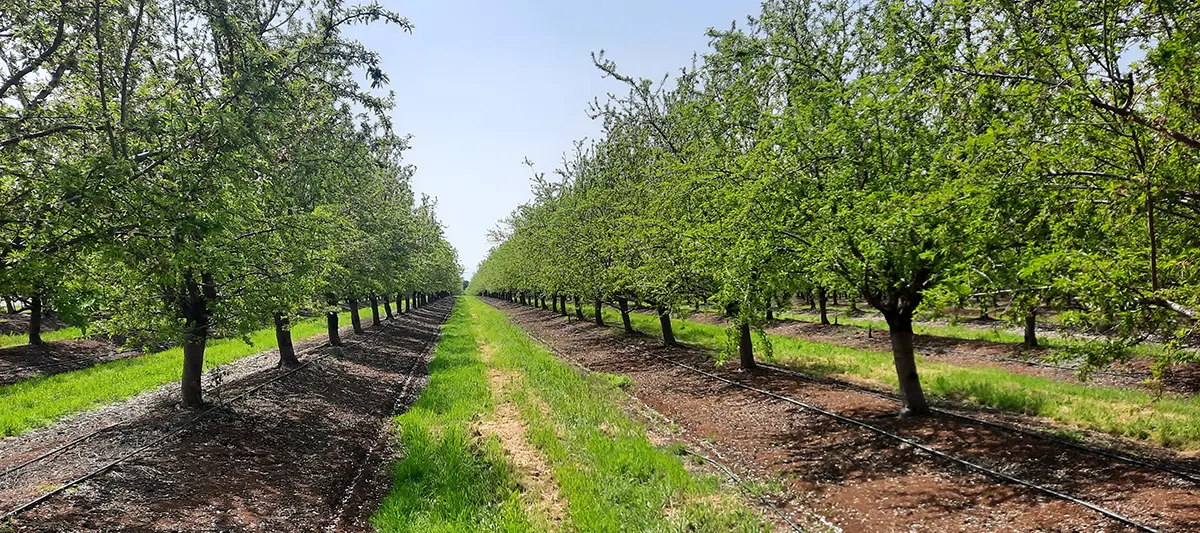
An almond orchard irrigation system must deliver water uniformly and efficiently over many years while adapting to changing seasonal demand. Effective drip irrigation for almond orchards depends on irrigation frequency, root-zone wetting, hydraulic uniformity, water quality and long-term maintenance—not only on how much water is applied.
What Affects Almond Irrigation Water Demand?
Water demand is not constant through the life of an orchard or throughout the season. Key factors include:
- Weather: Higher evapotranspiration increases water demand, while cooler or rainy conditions reduce it.
- Tree age: Young, smaller trees generally require less water than mature trees with a larger active root zone.
- Canopy size: A larger canopy increases transpiration demand; heavy pruning can temporarily reduce it.
- Seasonal stage: Demand typically rises as the canopy develops and can decline later in the season after shell hardening.
How Should Irrigation Frequency and Runtime Be Scheduled?
A practical starting point for almond irrigation scheduling is crop evapotranspiration:
ETc = ETo × Kc
ETc represents crop water demand derived from reference evapotranspiration (ETo) and the crop coefficient (Kc). The irrigation schedule should then be adjusted for effective rainfall, soil-water storage, system application rate and field measurements. Soil-moisture sensors, effective rooting depth and the depth of water applied in previous cycles help determine how often the system should operate and for how long.
Around harvest, timing requires special attention. In mechanically harvested almond orchards, irrigation is commonly stopped about three to four days before harvest and light irrigation resumed immediately afterward. Final timing should be adjusted to actual field and harvest conditions.
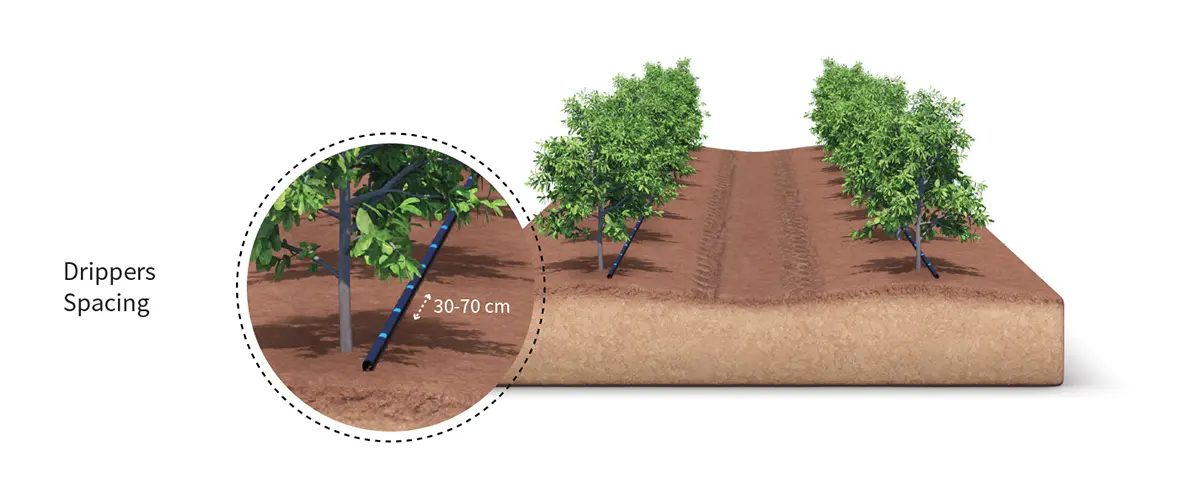
Match Dripper Spacing to the Soil Wetting Pattern
Dripper spacing should be selected according to the wetting pattern required in the active root zone. Soil texture, infiltration rate, emitter flow rate, irrigation duration, tree spacing and the number of drip laterals per row all influence the layout.
Coarse-textured or sandy soils usually create a narrower wetted pattern and may require closer emitter spacing, shorter irrigation intervals or more than one lateral per row. Fine-textured soils generally spread water farther laterally and infiltrate more slowly. The final configuration should be based on the orchard’s actual wetting pattern and the portion of the root zone that needs to be irrigated.
Design the Drip Irrigation System for Uniform Water Distribution
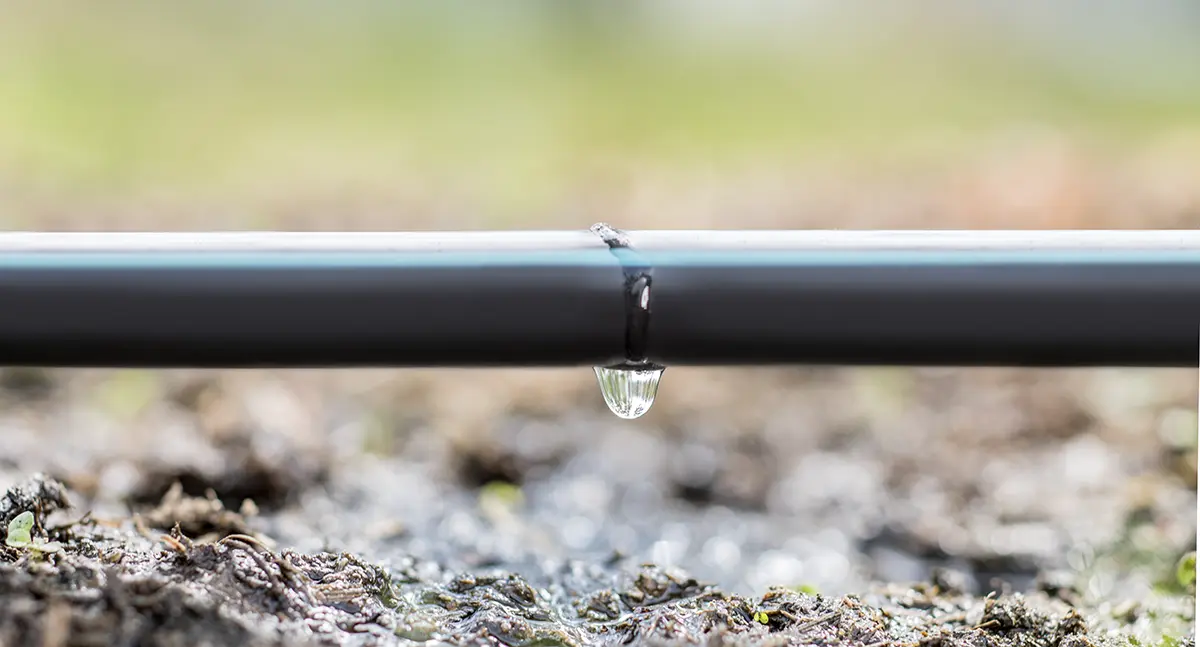
Uniform pressure and flow are essential across long rows, elevation changes and large irrigation blocks. Pressure-compensated driplines can help maintain consistent emitter discharge where pressure varies, but pressure compensation does not replace correct hydraulic design.
- Dripline & Emitter Specifications: Determine dripline diameter, maximum lateral length, emitter flow rate and emitter spacing according to the required flow and hydraulic conditions.
- Topography & Friction Losses: Account for elevation differences across the irrigation block and pressure losses along the laterals.
- System Capacity: Size mainlines, submains, pump flow and pressure, and filtration-system head loss to support the required pressure and flow throughout the operating block.
- Operating & Flushing Pressure: Determine the required inlet pressure, minimum flushing pressure and simultaneous flow for each operating block.
After installation, pressure and flow should be checked at predetermined representative points. Periodic distribution-uniformity testing can help identify new pressure variation or clogging events.
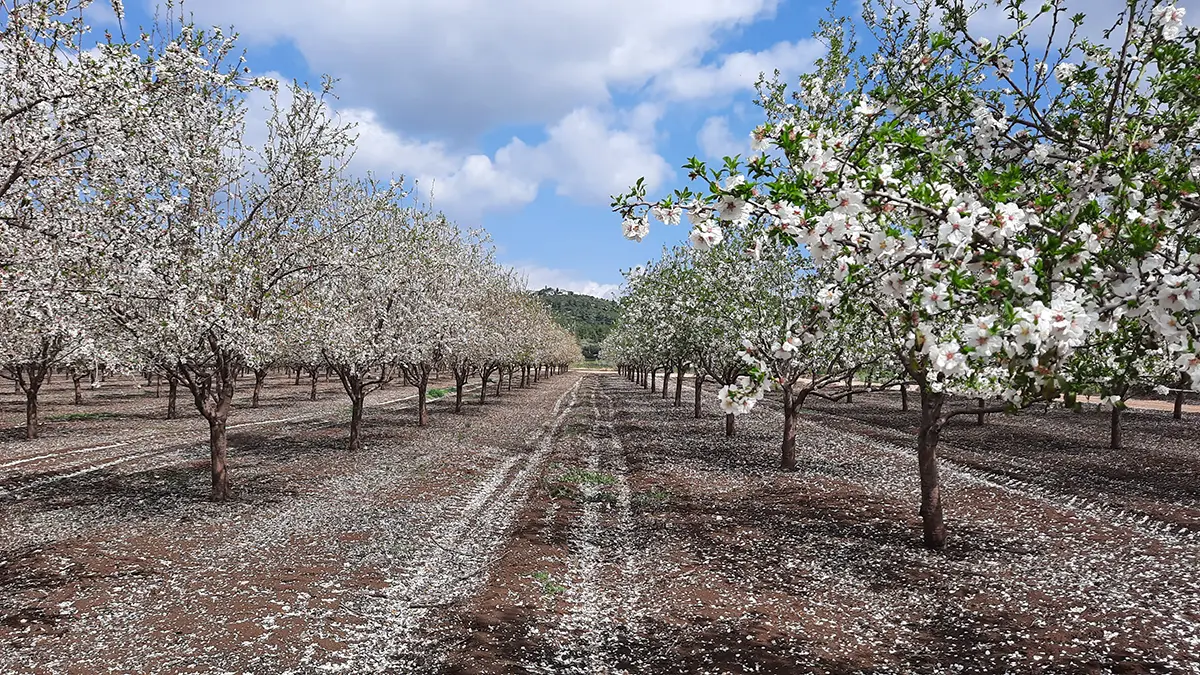
Surface or Subsurface Drip Irrigation for Almond Orchards?
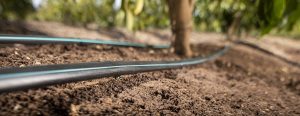
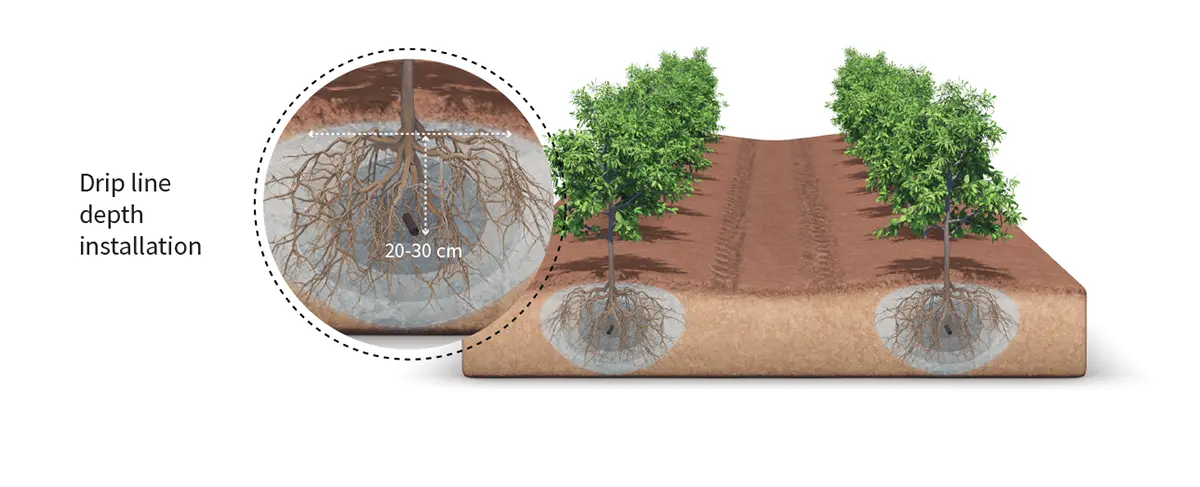
Surface drip irrigation keeps the laterals visible and accessible, making inspection, maintenance, and repositioning relatively simple. Subsurface drip irrigation (SDI), by contrast, places the dripline below the soil surface and delivers water directly within the root zone, helping reduce surface evaporation and runoff. Because SDI in a permanent almond orchard is designed as a long-term underground installation, its design must account for burial depth and distance from the tree row, filtration, flushing access, air-release and anti-vacuum protection, leak detection, root intrusion, and anti-siphon emitter technology. The choice between surface and subsurface drip should therefore be based on orchard conditions, maintenance requirements, and the long-term irrigation strategy.
For long-term SDI, root intrusion is a specific risk. Metzer’s RootGuard Band® is designed to prevent roots from entering dripline outlets and blocking emitters. Where irrigation water has high organic content, including treated wastewater, CleanLine® driplines provide protection against biofilm buildup inside the line.
Manage Water Quality, Filtration and Salinity
Water quality is a core irrigation-design parameter. Clogging risk can increase with:
- Suspended solids
- Biological material
- Precipitating minerals
- Organic matter
Filtration and maintenance should be matched to the actual water source and emitter type. As a practical Metzer filtration rule, particles that threaten emitter passages should be removed at approximately four times smaller than the emitter opening, or as fine as economically feasible. The system should also include accessible flushing points.
Plan Almond Irrigation From the Field Conditions Outward
Effective almond orchard drip irrigation starts with the orchard’s actual irrigation requirements rather than a predefined dripline configuration. Once water demand, irrigation frequency, soil wetting behavior, hydraulic conditions, installation method and water quality are defined, the appropriate emitter type, dripline and system layout can be selected. Metzer’s portfolio supports both surface and subsurface almond irrigation with pressure-compensated, anti-siphon and protected SDI technologies for long-term orchard performance.